Title: The Art Analog Workspace: Why Tactile Planning Boosts Focus
In an era defined by endless notifications, cloud-synced calendars, and the relentless glow of high-resolution monitors, the physical desk has often become an afterthought. We treat our workspace as a mere staging ground for our devices, yet we overlook the profound cognitive impact of the environment itself. Embracing the Art Analog Workspace is not about rejecting technology; it is about reclaiming the sensory experience of thinking.
When you shift from a purely digital planning system to a tactile one, you engage parts of the brain that remain dormant when you are simply typing or tapping. The friction of pen on paper and the physical manipulation of objects create a unique cognitive map. This shift in methodology can lead to improved memory retention, deeper focus, and a more intentional approach to your daily goals.
The cognitive science behind physical planning
There is a distinct neurological difference between typing on a keyboard and writing by hand. Research indicates that the physical act of writing triggers a process called encoding. When you form letters and organize thoughts on paper, your brain must process and synthesize information much more deeply than it does when you are merely inputting data.
Encoding information through sensory input
When you use a physical planner or a notebook, you are engaging your tactile and kinesthetic senses. You feel the texture of the paper, the weight of the pen, and the resistance of the nib. This sensory feedback loop acts as a signal to your brain that the information being recorded is significant.
Digital inputs are often fleeting and ephemeral. Because typing is fast and easily editable, we often record information without truly digesting it. Conversely, the deliberate pace of handwriting forces you to summarize and clarify your thoughts before you even commit them to the page. This intentionality is the foundation of high-level productivity.
Reducing cognitive load with external storage
Your working memory is limited. Trying to hold onto a mental to-do list while simultaneously attempting to solve complex problems is a recipe for burnout. By offloading your tasks into a physical notebook, you clear your mental workspace.
The act of physically crossing off a task provides a tangible sense of closure that a digital checkbox often lacks. This small ritual releases a burst of dopamine, reinforcing positive habits and providing a visible record of your progress. Seeing a day’s worth of completed work in ink serves as a powerful motivator to maintain momentum.
Designing a space that encourages deep work
A workspace should be an extension of your mind. If your desk is cluttered with cables, loose papers, and distracting gadgets, your focus will inevitably fracture. Creating an environment that supports tactile planning requires a shift in how you view your desk setup.
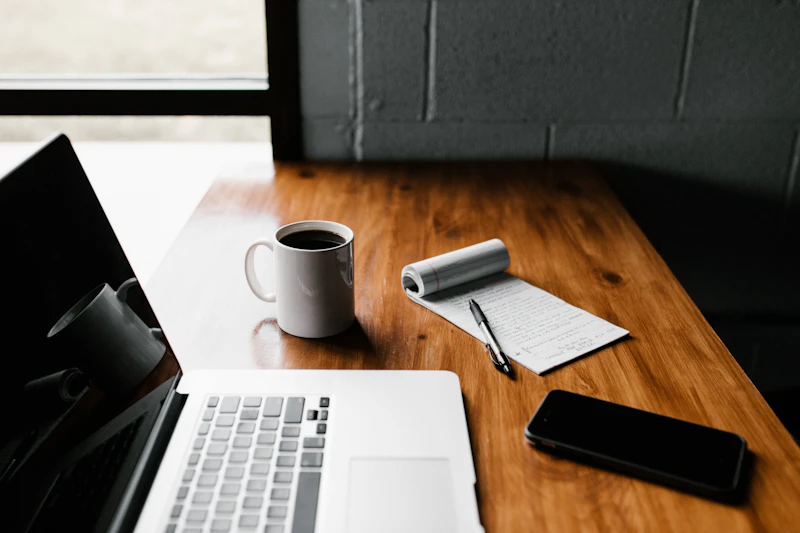
Start by clearing a dedicated zone for your analog tools. This does not mean you need to remove your computer, but rather that you should create a “thinking station” alongside it. When it is time to brainstorm or plan your week, move your body to this space.
Selecting the right analog tools
The tools you choose should be a source of inspiration rather than just utility. A high-quality notebook with paper that feels substantial can make the act of planning feel like a ritual rather than a chore. Similarly, choosing a pen that fits your hand comfortably encourages longer writing sessions.
Avoid the temptation to over-complicate your analog system. You do not need expensive leather journals or complex fountain pen setups to succeed. The most effective system is the one that you actually use. Focus on simplicity: a notebook, a reliable pen, and perhaps a few sticky notes or index cards for capturing fleeting ideas.
The importance of physical boundaries
Digital distractions are infinite. When you are on your computer, a single click can take you from a productive task to a social media feed or an overflowing inbox. A physical notebook, however, is a closed system. It cannot send you notifications.
By keeping your planning analog, you create a boundary between your deep work and the noise of the internet. When you open your notebook, you are entering a space where the only potential for distraction is your own wandering mind. This makes it significantly easier to practice sustained, focused attention.
Integrating analog habits into a digital workflow
It is rarely practical to abandon digital tools entirely. The goal is to create a hybrid workflow where analog planning informs digital execution. Use your physical notebook for the “big picture” thinking-outlining projects, brainstorming, and setting daily intentions.
Once you have mapped out your day on paper, you can use your digital tools for their intended purpose: efficient execution. Use your calendar for appointments and your task manager for recurring reminders. By separating the planning phase (analog) from the execution phase (digital), you gain the benefits of both worlds.
The weekly review ritual
The most powerful use of a physical notebook is the weekly review. At the end of each week, take thirty minutes to look back at your physical notes. You will likely notice patterns in your thinking, recurring obstacles, and areas where you were most productive.
This retrospective analysis is difficult to perform on a screen. When you look at a digital list, you see a static set of tasks. When you look at your handwritten notes, you see the evolution of your ideas. You see the scribbles, the cross-outs, and the marginalia that show how you arrived at your conclusions.
Maintaining consistency over time
The effectiveness of an analog system depends on consistency. It is better to write one or two sentences in a notebook every single day than to spend three hours setting up a complex system that you abandon after a week. Treat your planning time as an appointment with yourself that you cannot miss.
If you find yourself struggling to keep up, simplify even further. Perhaps you only use your notebook for a morning brain dump or an end-of-day summary. Small, consistent actions are the key to building any lasting habit. Over time, these small entries will accumulate into a valuable archive of your professional and personal growth.
Conclusion: Finding clarity in the tangible
In a world that is increasingly virtual, the value of the physical realm has never been higher. By incorporating tactile elements into your daily routine, you move away from the frantic pace of digital consumption and toward a more thoughtful, deliberate existence. You are not just managing your time; you are actively engaging with your priorities.
The beauty of this approach is its accessibility. You do not need to overhaul your entire office or purchase expensive equipment. You simply need to pick up a pen and choose to be more intentional with how you record your thoughts. As you build your own version of this practice, you will likely find that your focus sharpens and your anxiety decreases.
Ultimately, productivity is not about how many tasks you complete, but about the quality of the attention you bring to your work. By grounding your planning in the physical world, you create a sanctuary for your best ideas to develop. Start small, stay consistent, and enjoy the clarity that comes from putting pen to paper.